

Is your stock not paying dividends? Are you looking for ways to generate additional cash flow from the stocks you already own? Covered call options might be the solution. They offer a strategic way to earn extra income while holding onto your favourite stocks. Although covered calls can seem daunting initially, once you understand them, they become a powerful tool in any investor’s arsenal, providing benefits beyond basic stock ownership.
Understanding covered call options
A call option is a financial instrument that gives the buyer the right, but not the obligation, to purchase your stock at a specified price (the strike price) by a specific date (the expiration date).
In a covered call strategy, you act as the seller of call options, selling them against stocks you already own. This allows the buyer of the option to purchase your stock at a predetermined price if exercised.

Some investors use covered calls to potentially generate additional income from stocks they hold. This strategy is sometimes incorporated as part of broader investment approaches, such as managing price targets or rebalancing portfolios.
Covered calls are often used in neutral to moderately bullish markets, where large price gains are not anticipated. As with all options strategies, covered calls involve specific risks and trade-offs that investors should fully understand before implementation.
How covered calls work in practice
Imagine you own 100 shares of a stock called XYZ purchased at $5, and each share is currently trading at $8 per share. You don’t think the stock price will go up much in the next couple of months, so you decide to try out a covered call option.
Let’s say you find a call option on XYZ with a strike price of $10 that is selling for $0.50 per contract expiring in 60 days. You decide to sell 1 of these call option contracts, which will give you an immediate cash flow of $50 ($0.50 x 100 shares per contract).
Now, a few things can happen over the next 60 days:
- If the XYZ stock price stays below $10, the option buyer won’t exercise the option, and you get to keep the $50 you received from selling the options.
- If the XYZ stock price goes above $10 at any point, the option buyer may choose to exercise the option and buy the shares from you at $10 per share. In this case, you would sell your 100 shares for $10 each, for a total of $1,000, and you would also keep the $50 you received from selling the options, giving you a total profit of $550 ($10 sale price – $5 purchase price + $0.50 option premium).
- Even if the XYZ stock price skyrockets to $100 per share, you would still only make the $550 profit because that’s the maximum you can make with this covered call strategy.
Understanding stock selection for covered call strategies
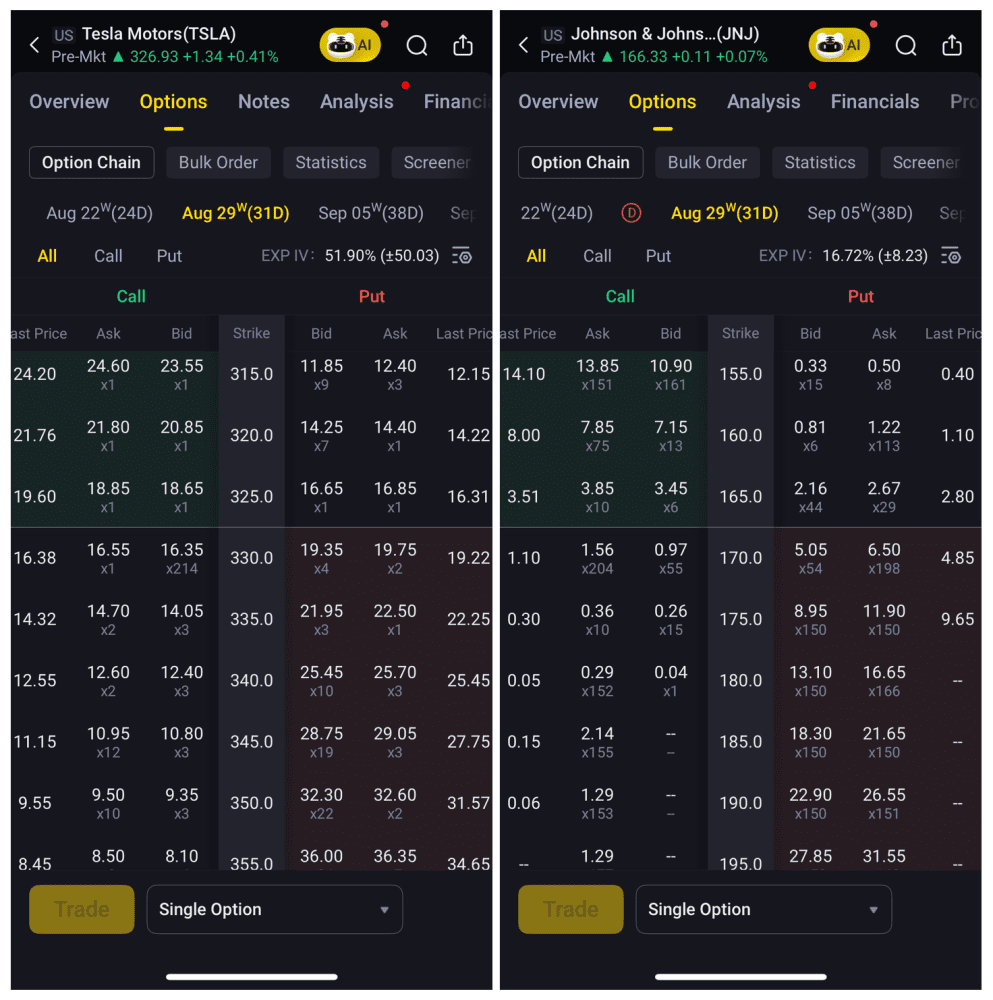
Covered calls are typically written on stocks already owned and that the investor is willing to sell if assigned. Stock traits such as volatility and valuation play a role in this approach. High-volatility stocks often produce larger premiums but carry a greater chance of assignment. More stable stocks may generate smaller premiums with a lower likelihood of being called away. Understanding how these characteristics affect outcomes can help with strategy alignment and risk management.
Additionally, consider the stock’s volatility. Higher volatility often results in higher premiums but also increases the likelihood of the stock reaching the strike price. For example, volatile stocks might offer attractive premiums due to its price swings, while a more stable company might provide lower premiums with less risk as pictured below.
It’s important to align your strategy with your investment goals. A long-term investor might choose a higher strike price to keep the stock, though this usually results in a lower premium.
Important things to note
While covered calls are considered relatively low risk since your stock position backs the call, there are important factors to consider. In the U.S., one options contract typically covers 100 shares, so understanding this relationship is important before exploring the strategy. This approach can limit potential gains. If the stock price rises above the strike price, the option may be exercised, requiring the shares to be sold at that fixed price.
Some brokerages allow the sale of call options without owning the underlying shares, a practice known as writing naked calls. Naked calls carry theoretically unlimited loss potential. If the underlying security rises, the seller may need to deliver 100 shares per contract, potentially purchasing them at market price, which can lead to significant margin exposure. Covered calls, in contrast, typically involve owning at least 100 shares per contract to offset this risk. Understanding these risks is important when learning about covered call strategies.
The fifth perspective
Understanding covered call options can be a useful addition to your investment strategy. By writing covered calls, you may be able to generate extra income through premiums while continuing to hold your existing stocks. This approach can provide modest cash flow and potentially enhance returns without requiring you to sell your shares outright.
Covered calls can also encourage a more disciplined approach to selling, helping investors establish clearer exit points and reduce emotional decision-making. With thoughtful stock selection and attention to risk, covered calls can become a practical tool to support your broader financial goals.

???? Looking to enhance your options trading strategy while keeping costs low? Tiger Brokers offers one of the lowest options pricing structures in Singapore with commissions at just USD 0.35 per contract and a platform fee of USD 0.30 per contract.
Unlike many brokerages that only support single-leg options (often resulting in higher cumulative fees), Tiger supports multi-leg options, allowing you to execute more complex strategies like spreads and straddles in a cost-efficient, one-step process. This flexibility not only helps reduce trading costs but also opens the door to a variety of strategic opportunities across different market conditions.
Besides US Options, Tiger Brokers also offers access to HK Options, US Stocks, Hong Kong Stocks and Singapore Stocks. Plus, Tiger Brokers has now waived the quarterly custody fee of SGD 2 for inactive SGX stock accounts until further notice.
Whether you’re new to options, looking to scale your strategy or planning to trade stocks, Tiger Brokers makes it smarter, simpler, and more affordable. Whether you’re new to options, looking to scale your strategy or planning to trade stocks, Tiger Brokers makes it smarter, simpler, and more affordable.
Disclaimer: Not financial advice. Investment involves risk. This advertisement has not been reviewed by the Monetary Authority of Singapore.

