

The world of investing is well in the middle of a drastic shift, led by Millennials (also including Gen Y, born between 1981 and 1996) and Gen Z (born between 1997 and 2012). These generations are not just entering the market earlier but also rewriting the rules with their preferences for technology, alternative assets like crypto, and other values-driven decisions. Such approaches are not only influencing the individual portfolios, but for the entire financial landscape. In this article, we will explore how they are reshaping the space of investing and what it really means for the future.
Starting early
It’s no secret that younger generations are starting their personal finance journeys earlier than those before them. For instance, Gen Z begins investing at an average age of 19, compared to 25 for Millennials and 35 for Baby Boomers. This early start allows them to harness the power of compounding over a longer time horizon—an essential advantage in building long-term wealth.
Their tech-savvy nature further sets them apart. Today, with tools like robo-advisors, mobile apps, and zero-commission trading platforms, investing is more accessible than ever. The rise of fractional investing has also enabled young investors to buy shares of high-value companies such as Berkshire Hathaway, Tesla (which traded around $2,200 before its 2020 stock split), and Nvidia (which traded near $1,200 before its 10-for-1 split), even with minimal capital. This democratization of finance has opened the door to broader participation, transforming investing from an exclusive activity for the wealthy into a part of everyday life.
The rise of alternative and values-driven investing
The younger generation is no longer just sticking to traditional assets such as stocks and bonds. Cryptocurrencies, NFTs, private equity, and collectables have also captured their attention, comprising 31% of the portfolio, while in the case of older investors, this segment constitutes only 6%. Thus, it reflects their openness toward innovation and higher risk tolerance, as well as their willingness to explore high-risk, high-reward opportunities.
But there is a surprising fact that it is not all about chasing returns: Millennials and Gen Z are values-driven investors. Data found that Millennials contributed $51.1 billion to sustainable funds in 2020 alone, more than a tenfold rise from less than $5 billion just five years prior. The exponential growth underlines how the younger generations’ investments align with their values, particularly regarding environmental, social, and governance (ESG) issues. Their focus on sustainability has also reshaped corporate practices, pressuring companies to adopt more ethical and responsible strategies.
Challenges faced by younger investors
Investing has never been easier – or riskier. While technology has lowered barriers to entry, it has also exposed younger investors to a new set of risks.
- Misinformation and scams: According to a survey by Nationwide Retirement Institute, 41% of Gen Z and 34% of Millennials investors have encountered and acted upon financial information seen online or on social media that turned out to be misleading or factually incorrect. Social media is now flooded with financial advice, but not all of it is reliable. The recent rise of finfluencers” – financial influencers who aim to make financial education more interesting – has actually created a double-edged sword. While some offer genuine insights, many lack credentials, and scammers are quick to exploit this trend. With advances in AI technology, impersonation scams have become more sophisticated and common, making it increasingly difficult for inexperienced young investors to differentiate credible advice from misleading or fraudulent content. This leaves the younger generation vulnerable in their pursuit of financial knowledge.
- Speculative behaviour: The allure of high-reward investments like meme stocks and cryptocurrencies often leads to impulsive decisions among young investors. These high-return, high-volatility assets can trigger the fear of missing out (FOMO). In fact, data shows that 41% of Gen Z investors in the U.S. and Canada cite FOMO as a key factor in their decision to start investing. This tendency can result in a lack of proper research on investment holdings, with decisions based solely on online hype or trends. Such behaviour often creates a herding effect, as exemplified by the GameStop short squeeze, where collective action drove stock prices to unprecedented levels without regard for fundamentals.
- Lack of formal education: While Gen Z investors have access to a wealth of financial information, their top sources are social media and internet searches, which reflect a reliance on unstructured, informal learning that can expose them to misinformation. Without formal education, which 23% of Gen Z investors lack, many turn to platforms like TikTok, Instagram, and Reddit, where advice can be engaging but not always credible. While online resources do provide opportunities for self-driven learning and democratising financial knowledge, the absence of structure can make it difficult for them to filter reliable advice from misleading content.
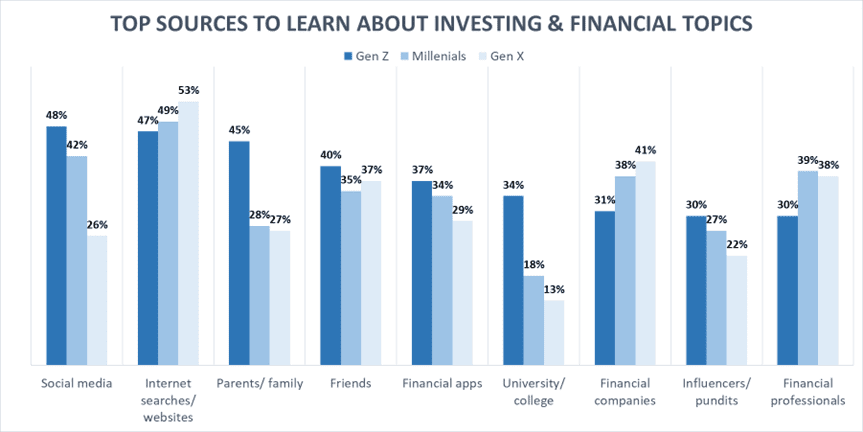
These challenges underscore the importance of financial literacy. While digital tools provide convenience, they also demand caution.
How younger investors are influencing the investing world
After reading the challenges faced by the younger generation, but they are also quietly bringing significant changes to the financial markets, shaping the investment world.
- Rise of alternative and ESG investments: Many major banks and financial firms have begun to offer cryptocurrency-related services, such as Fidelity’s Bitcoin custody service, which has attracted over $1 billion in assets under management. Not only that, as mentioned above, younger investors surprisingly also have a strong focus on ESG principles, which also accelerate sustainable investing. This demand is also influencing companies to adopt ethical and sustainable practices to attract these value-driven investors.
- Changes in financial institutions’ engagement strategies: After realising that younger generations get most of their financial information through online platforms, traditional financial institutions are adapting their engagement strategies. Many are enhancing their digital presence by creating content on YouTube, Instagram, and TikTok to explore younger audiences. Not only that, some firms collaborate with influencers to disseminate information and build trust. For example, Singapore’s DBS Bank launched the TableTok series on TikTok to teach young adults about financial literacy and Malaysia’s Maybank partners with influencers to promote their financial products and services.
- Increased market volatility: The younger generation’s higher risk tolerance and preference for speculative assets like meme stocks and crypto have introduced new volatility to financial markets. Events like the GameStop short squeeze, fuelled by social media hype and collective online action, highlight how quickly this demographic can influence stock prices. While this brings excitement to the markets, it also adds unpredictability as trends often shift based on sentiment rather than fundamentals.
The fifth perspective
Looking ahead, the evolving priorities of the younger generation will undoubtedly drive the development of more accessible, innovative, and values-driven investment opportunities. Investing will become increasingly technology-centric, with AI-powered platforms, robo-advisors, and seamless app-based experiences becoming the norm. The trend of starting to invest at a younger age is likely to persist, giving these investors the advantage of longer time horizons. Coupled with typically having fewer financial dependents, this may also encourage a greater appetite for risk. Traditional financial institutions are expected to adapt by incorporating digital assets like cryptocurrencies and offering more sustainability-focused ETFs to align with generational preferences. The key for investors today is to stay flexible, embrace innovation, and be ready to adapt to an ever-evolving investment landscape.

