
Last week, I updated an article on the top 10 Singapore REITs that would have made you money if you had invested since their IPOs. Out of the 25 S-REITs that have been listed for at least 10 years, 18 have delivered a positive overall return for investors.
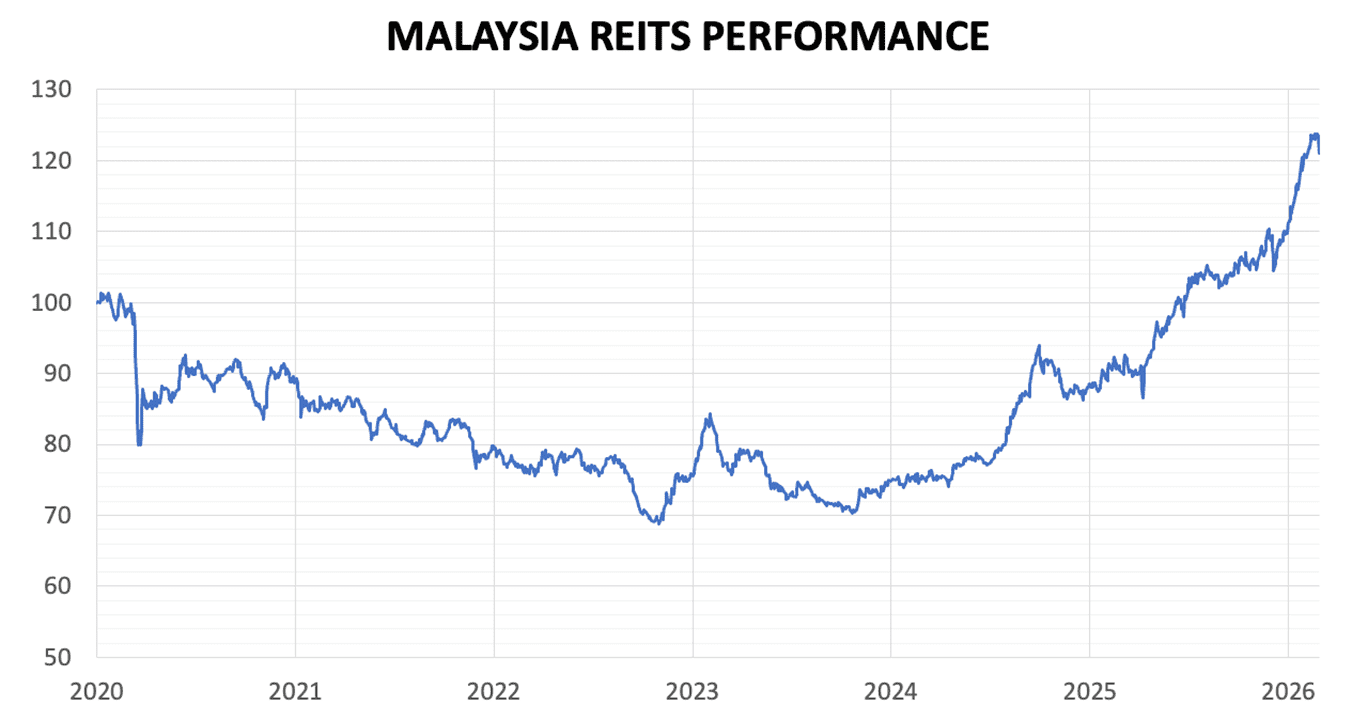
In this article, we measure the performance of REITs listed in Malaysia. Following the onset of the COVID-19 pandemic in 2020, Malaysian REITs, which are largely concentrated in the retail and office segments, experienced significant headwinds due to suppressed consumer spending. However, in 2024, REIT prices staged a strong recovery across the board. This momentum accelerated in 2025, with the overall index now trading above pre-pandemic levels.
A primary catalyst has been the surge in tourism. As international and domestic visitor numbers surpassed their 2019 peaks, footfall and tenant sales at flagship malls increased sharply. This “reopening tailwind” allowed landlords to secure positive rental reversions, prompting local investors to revalue Malaysian REITs over the past two years.
Unlike the Singapore market, where the 2025 recovery was largely driven by interest-rate relief, the recovery in Malaysia has been more closely tied to organic earnings growth and tourism-led spending.
In this article, we will measure the performance of REITs with a listing history of at least 10 years. In total, there are 16 Malaysian REITs (M-REITs) that went public in 2016 or earlier, and there were no new additions to this group this year.
We will make a similar assumption that Sophia (a fictional character) invests RM1,000 in each of these REITs on the day they were listed. Since Sophia is a hard-core income investor, she does not want to put in additional money to subscribe to any rights issues (if any) and is prepared to accept any resulting share dilution. We also assume that she neglects to sell her nil-paid rights, even though she could have made a profit from them.
For example, if Sophia had invested in Sunway REIT during its IPO in 2010, her initial investment of RM1,000 would have grown to RM2,800 (+180% in capital gains) by 27 Feb 2026. On top of that, she would have collected RM1,500 in total dividends (150% in distributions).

From the table above, Sophia would have made a nice return from Sunway REIT. Her initial investment of RM1,000 would have grown to RM4,300, including the dividends received over the years. If she had invested RM10,000 instead, her investment would have grown to RM43,000. An investment of RM100,000 would have turned into RM430,000.
In simple terms, the more money she invests, the more she stands to make. And the longer she holds, the more dividends she will receive. All in all, her annualised return from Sunway REIT alone works out to 9.54% from 2010 to early 2026.
So after investing for more than 10 years, here are the top five best-performing Malaysian REITs for Sophia, ranked by annualised return.
Note: We’ve excluded brokerage costs, currency exchange gains/losses and taxes that might be applicable to foreign investors.
5. Atrium REIT (Annualised return: +5.49%)
Since 2007, every RM1,000 invested in Atrium REIT would have grown to RM1,300 in capital value. Including dividends, every RM1,000 invested would have cumulatively grown to RM2,760.
4. IGB REIT (Annualised return: +8.48%)
Since 2012, every RM1,000 investment in IGB REIT would have grown to RM1,820. Including dividends, every RM1,000 invested would have cumulatively grown to RM3,120.
3. Pavilion REIT (Annualised return: +8.37%)
Since 2011, every RM1,000 investment in PAVREIT would have grown to RM2,220. Including dividends, every RM1,000 invested would have cumulatively grown to RM3,460.
2. Axis REIT (Annualised return: +8.98%)
Since 2005, every RM1,000 investment in Axis REIT would have grown to RM3,250. Including dividends, every RM1,000 invested would have cumulatively grown to RM6,060.
1. Sunway REIT (Annualised return: +9.54%)
Since 2010, every RM1,000 investment in Sunway REIT would have grown to RM2,800. Including dividends, every RM1,000 invested would have cumulatively grown to RM4,300.
In summary, here is Sophia’s overall performance:
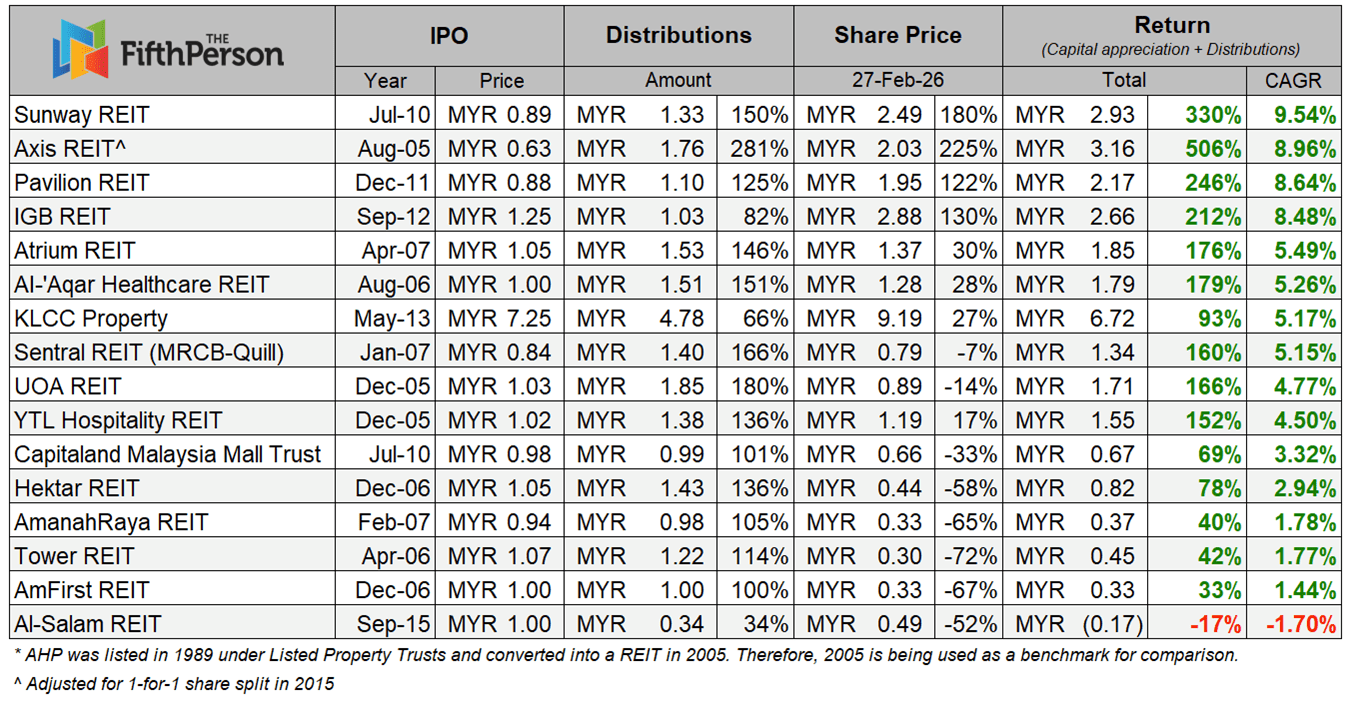
As you can see, Sophia’s M-REIT portfolio is a sea of green, except for Al-Salam REIT, which is a new entrant this year. Overall, Malaysian REITs have delivered consistent dividends and positive total returns for investors who held them since their IPOs.
In fact, dividends accounted for about 84.1% of the total return. During bear markets, such as the period from 2020 to 2023, these dividends help cushion the downside. But when the bull market returns, capital gains help boost the overall return.
While the ringgit showed improved resilience in 2025, many international and Singapore-based investors remain wary of the currency’s long-term historical volatility. For these investors, any gains in distribution yields could potentially be eroded by a weakening Ringgit when converted back into their home currencies.
However, for Malaysian investors, this currency risk does not exist. Since M-REITs are traded in ringgit and collect most of their rental income in ringgit, they serve as a stable and effective vehicle for building a consistent stream of passive income without the friction of exchange rate fluctuations.
📢 Announcement: 2026 Enrolment for Dividend Machines is Now Open! If you’re looking to learn how to invest in dividend stocks and REITs while building multiple streams of passive income, we highly recommend checking out Dividend Machines before enrolment closes! Once the deadline passes, Dividend Machines won’t reopen until 2027. Start investing for cash flow today!


Please talk about stocks or reits when they are undervalued. All the reits mentioned are no longer cheap.